
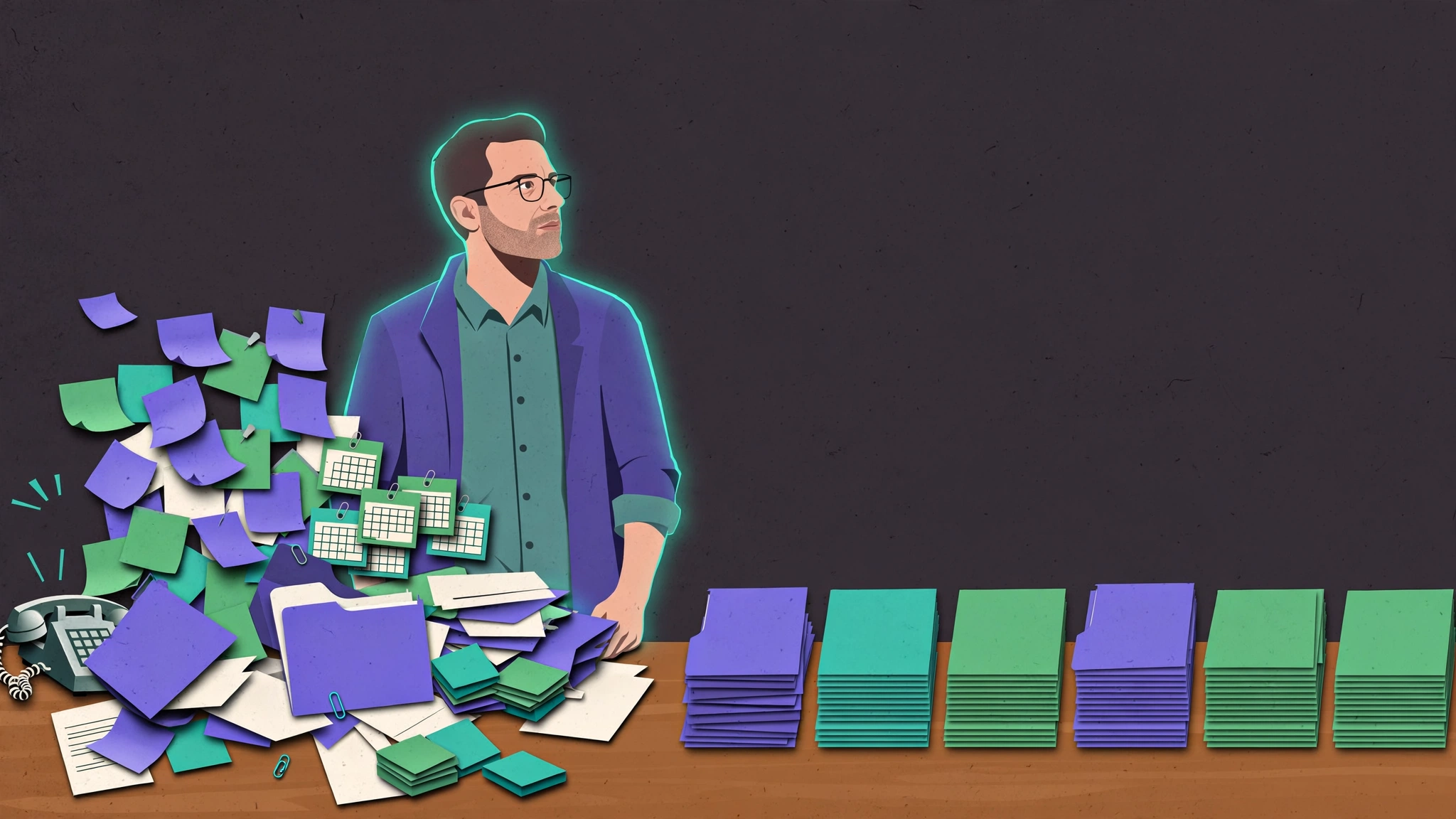
Your assistant texts during a client meeting. Can they confirm tomorrow at four? You step out to reply. Before you sit back down, a file needs your yes, a past client is waiting on an update, and a new inquiry is sitting unanswered. None of this is complicated. All of it waits on you.
When every decision, follow-up, client response, and routine task routes through one person, the business only moves when you are available. Replies slow down. Deals pause. The conversations that actually need you get squeezed behind work someone else could finish with a clear guide.
You do not need a complicated stack to change this. You need repeatable work out of your head, simple rules other people can follow, and enough protected time to stay human with the clients who matter. That is how you add hours back to your week without tech overwhelm.
How a business becomes dependent on one person
Early on, doing everything yourself is a strength. In real estate, mortgage, and sales, your voice closes more business than a template ever will. You answer fast. You catch the details. Clients feel the relationship.
Then volume rises. You hire help, or you promise yourself you will. The assistant still waits for approval on a showing text. The processor still needs you to decide if a file is ready. Your inbox becomes the operating system. Team members hesitate because the last time they moved without you, something had to be undone.
Staying in every loop feels safer. You keep the relationships. You keep the quality. The hidden cost is capacity. Every hour spent on work that repeats is an hour you cannot spend with a client, on the offer, or on the next hire. The business cannot grow past the hours you personally have.
Document the work that repeats so it can leave your head
If a task happens the same way most weeks, it should not live only in your memory. Write it down in plain language: what starts it, what good looks like, and when it should come back to you.
Use this as a starting list this week:
- Name ten tasks you still approve by habit, such as showing confirmations, document-received notes, or listing updates.
- Pick one and walk through it out loud, as if you were training a trusted person for the first time.
- Turn that walkthrough into a one-page guide: trigger, steps, finished result, and the one exception that still needs you.
- Have someone else run it once while you watch. Fix the gaps. Then let them run it without you in the room.
The first guide will feel slow. The tenth one is how a solopreneur or team leader stops being the only person who knows how the business works.
Automate the follow-ups that do not need your judgment
A reminder that documents arrived, a thank-you after a showing, or a check-in on day three does not require your live attention. Those messages can go out in your voice, on a schedule, from the CRM you already use.
Keep yourself in the conversations that change the outcome: the worried buyer, the file with a wrinkle, the referral who wants to talk to you. Automation should clear the path to those moments, not replace them. That is the human touch worth protecting.
- Map a simple sequence: day one thanks, day three nudge, a clear handoff when someone replies.
- Write the messages the way you actually talk. Short. Specific. Warm.
- Send only the exceptions to you: questions, objections, and anything that needs a judgment call.
If the system feels noisy, reduce it. A few reliable follow-ups beat a maze of tools you will not maintain.
Write decision rules so work can move without waiting
Documentation tells people how. Decision rules tell them when they can proceed. Without those rules, even a good assistant will pause and ask, because asking feels safer than guessing.
Write if-then lines for the calls you make on repeat:
- If the buyer is pre-approved and the time is open, confirm the showing.
- If the file is complete and within the stated guidelines, send it forward.
- If the lead came from a referral, book a short call on your calendar.
- If the request is outside those lines, bring it to you with the facts already gathered.
These rules also help you on a heavy Tuesday, when you would otherwise reinvent the same call you made last month. The business keeps moving while you stay with the work that needs your name on it.
Protect recovery time as operating capacity
A calendar with no white space is not a badge of demand. It is a sign that the business still requires you for everything. Recovery time is how you keep judgment sharp for clients. Block it the way you would block a listing appointment. Treat it as part of the operation, not a reward you earn after the inbox is empty.
When stress is crowding out the capacity to change how you work, rest has to be part of the plan. Ascend Advantage Commerce offers relaxation and therapy-oriented products chosen for businesspeople who need more room to reset. You cannot install better systems from an empty tank.
Build trusted support around the work only you should keep
Support can be a person, a tool, or both. A VA or team member can run the guides you wrote. Your CRM can carry the follow-ups you designed. You keep the relationships, the exceptions, and the decisions that shape the business.
If the bottleneck is the offer, the customer journey, or the systems underneath growth, you may need a partner who builds with you. Ascend Advantage Studio helps clients build and grow businesses with clearer offers and practical systems, so more of the operation can run without waiting on the owner.
Some weeks the weight of being the only one is the real problem. On those days, a system document will not be enough. When You Want to Quit shares Darren's personal story and honest motivation for the moments when carrying everything alone feels like too much. Those pages exist so you can remember why the work is worth building support around.
Start with the next conversation that fits
You do not have to fix the whole operation this week. Pick one repeating task, write the guide, and give it a place to live outside your head. Then take the shared Ascend Advantage Quiz for a personalized starting point. A few honest answers produce a data-backed roadmap for where AI and better systems can give you time back, without asking you to become a technology expert.
Take the quiz because it points you toward the conversation you need first: stronger systems, more room to recover, or a reminder that you do not have to carry this alone.
